Mount Kenya is not just a mountain; it is the "Throne of Ngai" to the local communities and a UNESCO World Heritage site that challenges even the most seasoned trekkers. As Africa's second-highest peak (5,199m), it offers a more technical and diverse landscape than Kilimanjaro, featuring jagged volcanic peaks, Afro-alpine moorlands, and ancient glaciers that sit directly on the equator.
The Quest for the Summit
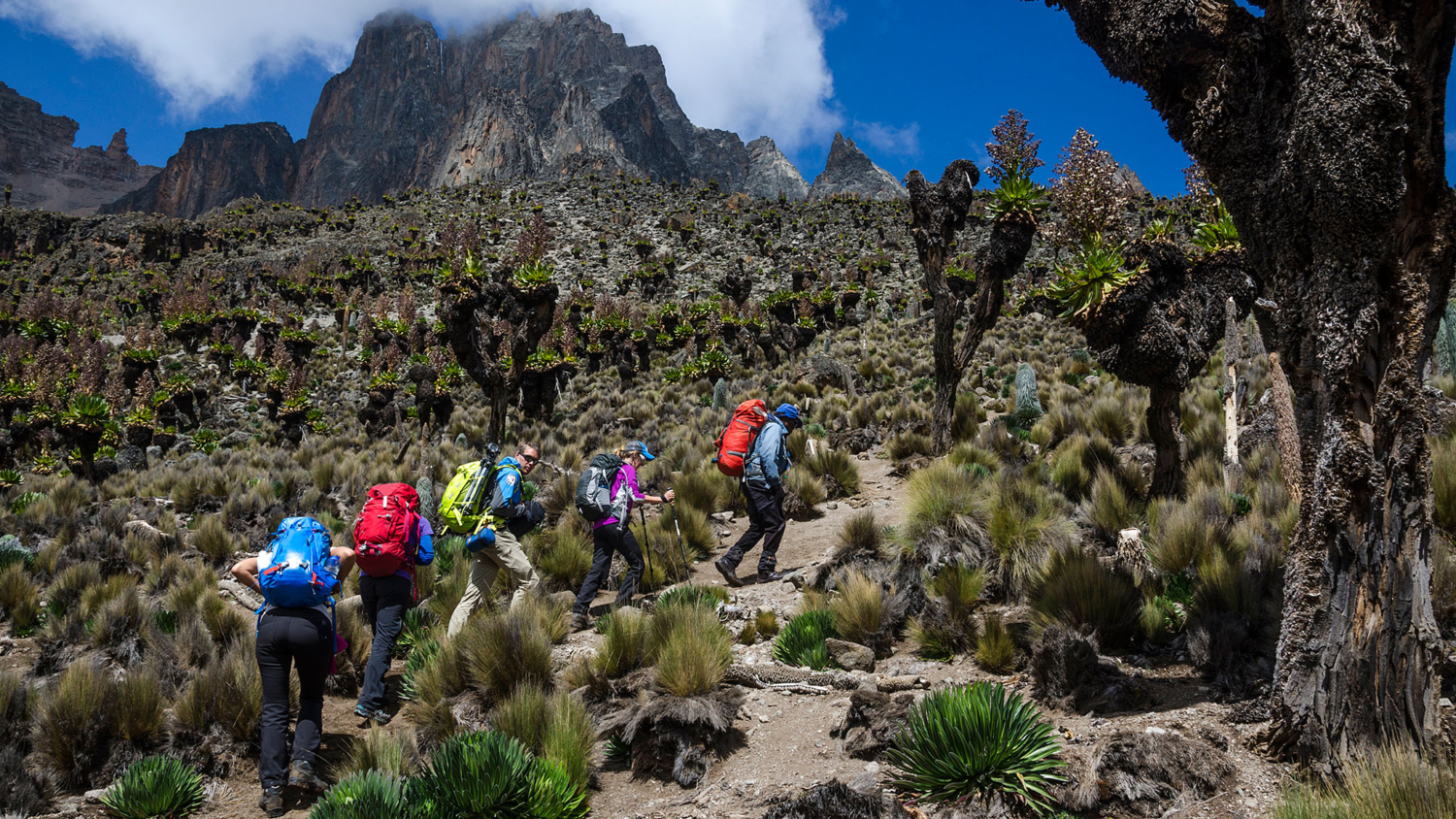
Climbing Mount Kenya is a journey through five distinct vegetation zones. From the lush bamboo forests filled with buffalo and elephant to the eerie, high-altitude world of Giant Lobelias and Senecios.
Sirimon Route: The most popular approach, known for its steady altitude gain and beautiful forest scenery.
Chogoria Route: The most scenic descent, passing by Gorges Valley and the spectacular Lake Michaelson.
Sirimon-Chogoria Transit Configurator
Simulate your transit logistics from Nairobi hubs to the park gates.
Nairobi to Sirimon Gate via clean specialized 4x4 cruiser infrastructure.
The Route Architect: Sirimon vs. Chogoria
The Sirimon Approach (The Logic of Ascent)
Sirimon is the most strategic route for international climbers due to its gradual altitude gain. Starting at 2,650m, the first day involves a steady trek through magnificent yellowwood and cedar forests. As you emerge from the canopy, the landscape shifts into the heath zone, where the giant heather (Erica arborea) can grow up to 10 meters tall.
Day 2 on Sirimon: This is the crossing of the Likii North Valley. Climbers face the dramatic sight of the main peaks, Batian and Nelion, emerging from the clouds. Shipton’s Camp (4,200m) serves as the base for the final push, nestled directly below the towering volcanic pillars of the summit massif.
The Chogoria Traverse (The Scenic Masterpiece)
If Sirimon is about logic, Chogoria is about beauty. Located on the eastern side of the mountain, this route is famous for the 'Temple'—a 150m vertical cliff overlooking Lake Michaelson. The descent via Chogoria is the most popular choice for "The Traverse" (Up Sirimon, Down Chogoria).
The Gorges Valley: Walking along the rim of the Gorges Valley offers views that rival any alpine landscape on Earth. The Nithi Gates and Vivienne Falls provide a lush, water-rich contrast to the stark, frozen world of the summit. This route adds an extra layer of visual storytelling for travel photographers.
Acclimatization Blood Oxygen Calculator
Predict how altitude increments stress your blood oxygen saturation ($SpO_2$) matrix.
The High-Altitude Kit: Preparation for -15°C
Layering Science
On Mount Kenya, the "Equatorial Sun" is a myth once you pass 3,500m. The temperature gradient is extreme. You need a 4-layer system:
- Base Layer: Merino wool fabrics (Avoid cotton).
- Mid-Layer: Heavyweight insulation fleece layers.
- Outer Shell: Waterproof Gore-Tex protective membrane.
- Premium Down: 700-Fill Down Coat for summit launches.
The Technical Pack
Your porters carry main bags limited to 15kg, but your daypack must maintain survival autonomy:
- 3L Hydration storage built via Insulated Travel Bottles to prevent freezing.
- High-calorie snacks, energy gels, and targeted trail nutrients.
- High-intensity LED headlamp matrix setups with spare arrays.
- Personal First Aid Kit sets featuring Diamox elements.
Ecological Zoning: A Vertical Garden
As you ascend Mount Kenya, you are essentially traveling from the Equator to the Arctic in a matter of days. This transition creates unique evolutionary niches found nowhere else on the planet.
The Bamboo Zone
Between 2,500m and 3,000m, dense bamboo setups create defensive perimeters harboring unique high-altitude elephant herds.
The Afro-Alpine Moorland
The iconic zone. Giant Senecios and Lobelias maintain specific leaf closure strategies to defeat structural frost cycles.
The Nival Zone
Above 4,500m. Scree terrain blocks where oxygen saturation factors match exactly 50% of maritime standards.
The Alpine Climate Shift
Mount Kenya creates its own localized microclimates. You will experience blistering equatorial sun radiating off rock walls by afternoon, transitioning abruptly to bone-chilling sub-zero winds at the valley floor camps overnight.
Equatorial Day Cycles
Ambient high factors tracking between 15°C to 22°C. Intense UV requires advanced protective sunscreen layers and moisture-wicking gear.
High Altitude Frost Nights
Past Shipton's base, parameters sink cleanly down between -5°C to -15°C. Demands premium technical insulation jackets.
Our Invisible Support System
We proudly refuse exploitative operations that sacrifice fair compensation structures for mountain logistics crews.
"Every single high-altitude cook and porter working under our banner is a professional. When you choose an ethical outfitter, your fees feed local mountain communities in Nanyuki, Chogoria, and greater Nakuru directly."
Safety Protocols & AMS Management
Understanding Acute Mountain Sickness (AMS)
Mount Kenya gradients ascend abruptly. Daily blood monitoring metrics using professional finger oximeter tracklines are locked into our daily camp routines.
The 5-Day Sirimon-Chogoria Traverse
Dist: 9km | Time: 3-4hrs
The Gateway to the Northern Slopes
The journey begins in the safari hub of Nanyuki, crossing the Equator before driving directly to the Sirimon Gate. The first few kilometers present a gentle introduction winding through magnificent montane forest systems where Colobus monkeys live.
As the canopy thins, you reach Old Moses Camp inside the heath zone. This is your initialization baseline night under deep star arrays where active physical adaptation processing begins.
Dist: 14km | Time: 6-7hrs
Across Mackinder's Valley
This day reveals massive dramatic expansions across the scenic horizon line. The trail crosses two high valley ridges before dropping down into the majestic Mackinder's Valley floor paths.
Surrounded by prehistoric Giant Senecios, you approach the rock structures of Shipton's Camp. Here, the sheer vertical volcanic spires of Batian and Nelion loom directly above your bunk lines, signaling proximity to the main alpine push vectors.
Trek Duration: 3-4 Hours Conditional
Strategic Oxygen Modification Protocol
A foundational rest step to lock in critical blood adjustments before demanding summit ascents. We execute short conditioning hikes up toward the high ridge loops of Hausberg Col (4,600m) to stimulate physical adaptation limits without exhausting essential muscle stores.
Afternoon hours are strictly reserved for deep dietary refueling, equipment checks, and hydration management inside the Shipton protection hubs.
Dist: 18km | Time: 10-12hrs
The Midnight Dawn Launch Vector
The ultimate push. Waking at 2:00 AM, climbers navigate frozen scree switchbacks under headlamp light arrays. By dawn, you step onto the frozen crest of Point Lenana (4,985m), watching the equatorial sunrise illuminate the plains of East Africa.
The traverse route descends down the eastern face into the dramatic cliff walls of Chogoria, leading straight to the edge of Lake Michaelson for a premium wilderness overnight stay.
Dist: 16km | Time: 5-6hrs
The Gorges Valley Extraction Path
The concluding leg treks along the rim of Gorges Valley, passing the Nithi Gates waterfall landmarks. Bamboo bands return as you reach the rainforest zone outposts near the main extraction gate.
Our 4x4 vehicles receive you at the gate for transit connections back to Nairobi, finalizing the ultimate equatorial mountain journey.